

Homeowner guide
Planning Drawings vs Building Regulation Drawings: What's the Difference?
Planning drawings and building regulation drawings are both part of most residential projects, but they serve completely different purposes. Planning drawings are a communication with the local planning authority about the design intent and visual impact of a proposal. Building regulation drawings are a technical specification for the building itself — structure, thermal performance, fire safety, drainage. Understanding the difference helps you budget correctly, ask the right questions, and avoid commissioning the wrong thing at the wrong stage.
Example planning & architectural drawings
Example plan sheets prepared by Crown Architecture
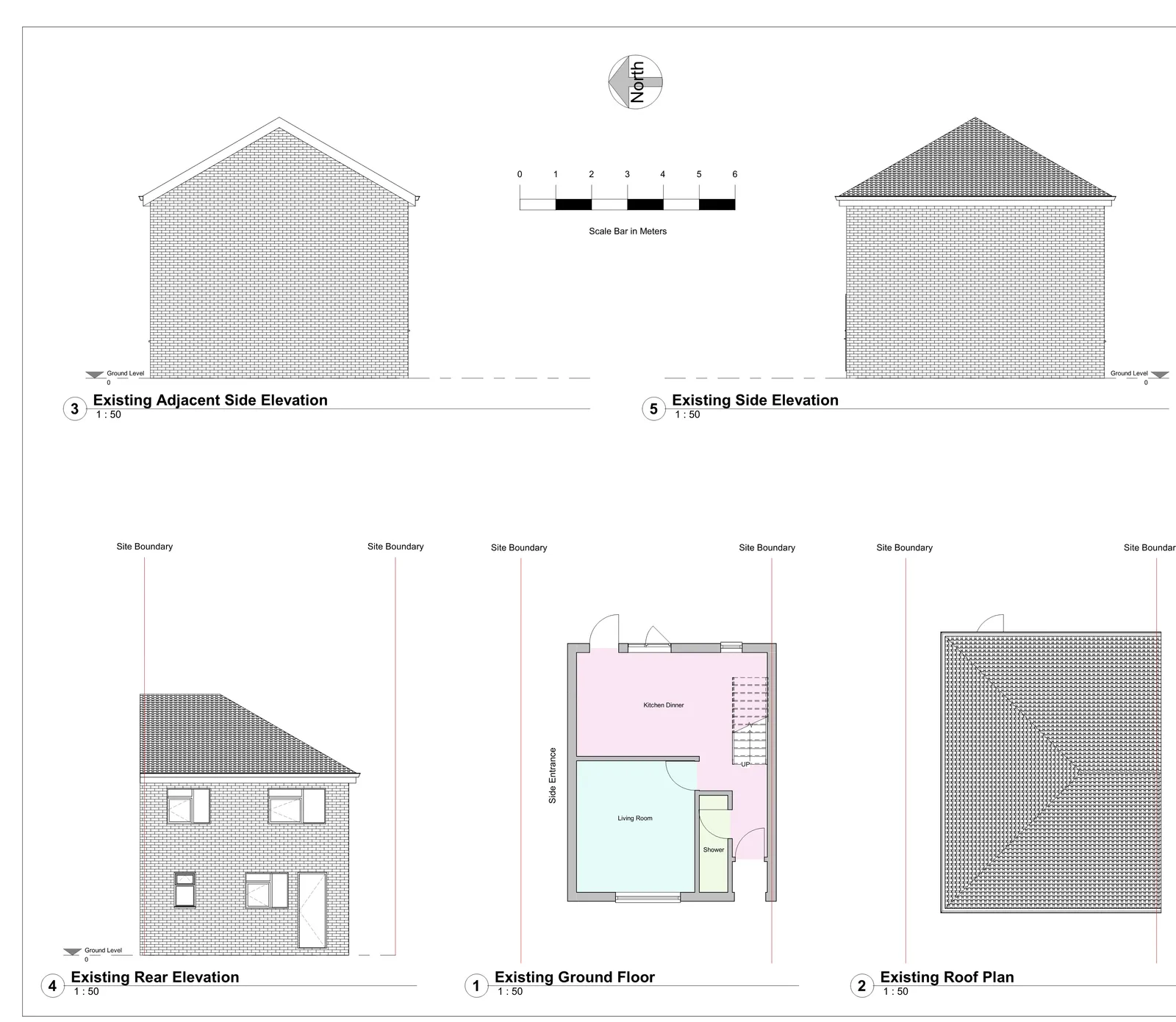
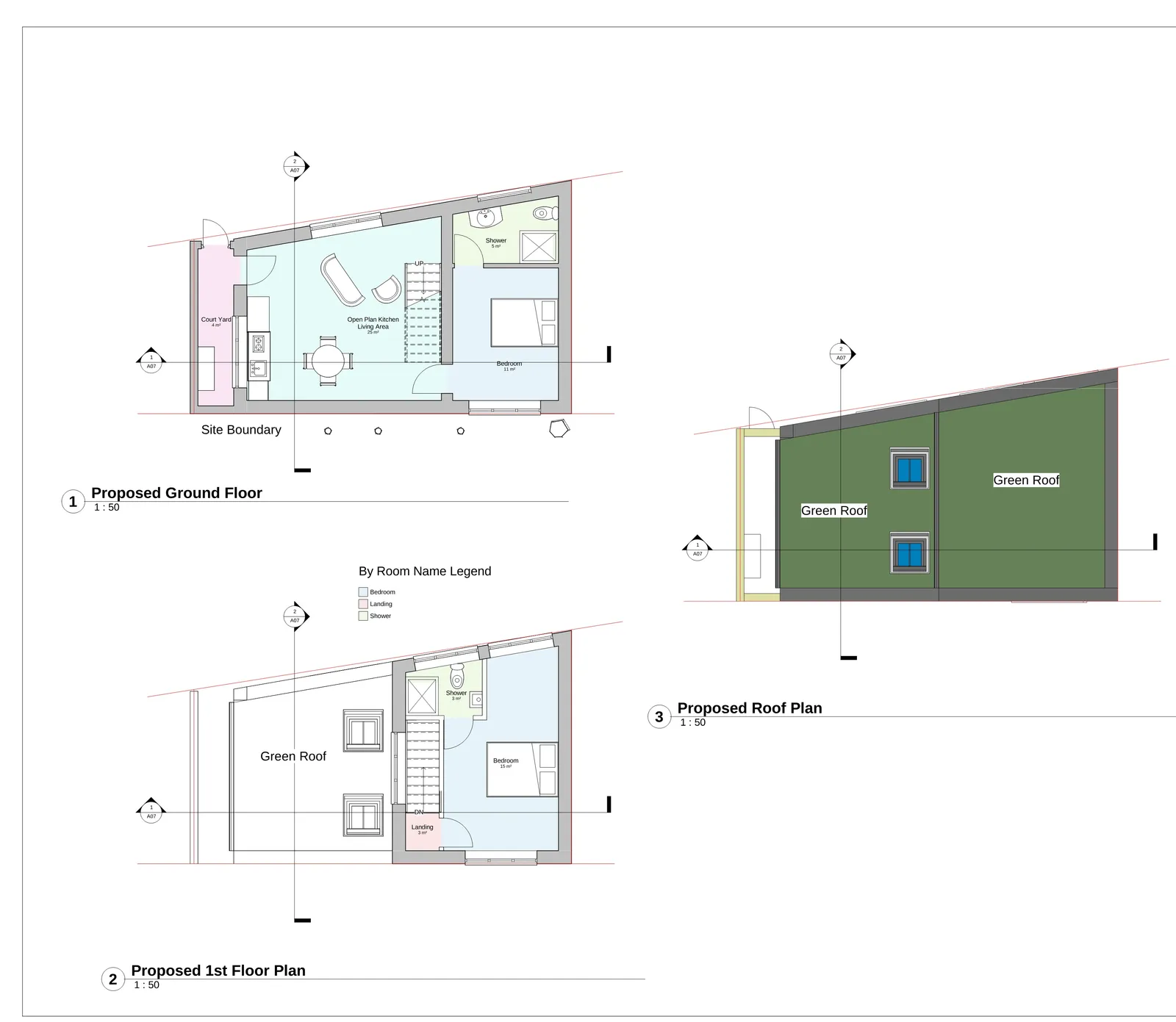
These example plan sheets show the type of architectural drawings, existing and proposed floor plans, elevations, roof plans, sections and 3D views Crown Architecture prepares for planning applications, permitted development, building control and residential design work. For homeowners, landlords and developers, Crown Architecture & Structural Engineering Ltd can prepare measured survey drawings, proposed layouts, planning drawings, building regulation drawings and supporting plan packages for extensions, loft conversions, garage conversions, internal alterations, HMO layouts and change-of-use applications.
Every project is reviewed around the property, the local authority requirements and the intended approval route, so the final drawing package is suitable for planning submission, building control coordination and contractor pricing where required.
Project imagery
Crown Architecture projects
Examples of the planning drawings, building regulation packages, and residential projects that this guide relates to.


Key information
What Planning Drawings Are For
Planning drawings are the documents you submit to your local planning authority (LPA) to apply for planning permission or lawful development certificate. They show the planning authority what you intend to build, how it relates to the existing building and the surrounding context, and what it will look like from the street, from the garden, and from neighbouring properties.
The planning authority uses your drawings to assess the proposal against national planning policy (the NPPF) and the council's local plan policies. The main questions are: Does this fit the character of the area? Does it harm the amenity of neighbours? Does it respect any heritage designations? Is it the right scale for the plot? Planning drawings must answer these questions visually and in the supporting documents.
Planning drawings are not construction documents. They do not show how the building is held up, what insulation is used, how drainage runs, or what materials are specified in technical detail. They show outline dimensions, external appearance, and site context — the information a planning officer needs to make a planning decision.
- Site location plan (OS-based, 1:1250 scale, boundary marked in red)
- Block plan showing the site and immediate surroundings (1:500)
- Existing floor plans — all floors of the current building
- Proposed floor plans — showing what changes are proposed
- Existing elevations — all affected sides of the existing building
- Proposed elevations — showing how external faces will look after the works
- Section drawings where required
- Design and access statement (required for conservation area applications and some listed building applications)
Need professional advice for your project? Crown Architecture offers free initial consultations.
Get a Free QuoteGuide section
What Building Regulation Drawings Are For
Building regulation drawings (also called building control drawings or technical drawings) are the documents you submit to building control — either your council's building control department or a registered building control approver (private-sector alternative) — to demonstrate that the proposed works comply with the Building Regulations.
The Building Regulations are a set of technical standards covering structure (Part A), fire safety (Part B), damp and weathering (Part C), drainage (Part H), ventilation (Part F), energy efficiency (Part L), accessibility (Part M), and other aspects of building performance. A building regulation drawing package must demonstrate compliance with all relevant Parts.
Unlike planning drawings, building regulation drawings are genuinely technical documents — construction drawings, not design proposals. They show beam and lintel sizes, foundation type and depth, insulation specification with U-value calculations, fire-rating of walls and floors, drainage routes and gradients, ventilation openings, and structural connections. A structural engineer's calculations are typically coordinated alongside the drawings.
Building control inspectors use these documents to assess the technical submission before work starts (full-plans application) and then to guide inspections during the works. At the end of the project, a Completion Certificate is issued, which is essential for conveyancing and mortgage purposes.
Guide section
The Key Differences
The simplest way to understand the difference is this: planning drawings are for the planning system, building regulation drawings are for the building system. They are two separate legal requirements, assessed by different people, at different stages of the project.
Planning comes first. You need planning permission (or permitted development confirmation) before building regulation approval is generally sought, though in practice both processes are often run in parallel for longer projects.
Planning drawings focus on external appearance, character, and planning policy compliance. Building regulation drawings focus on structural safety, thermal performance, fire escape, drainage, and building performance compliance.
| Feature | Planning Drawings | Building Regulation Drawings |
|---|---|---|
| Purpose | Obtain planning permission or LDC | Obtain building control approval |
| Submitted to | Local Planning Authority | Building Control / RBCA |
| Stage | Before work starts | Before or during work |
| Level of detail | Outline (appearance, layout) | Full technical detail |
| Structural content | Minimal / indicative | Full specification + calculations |
| Insulation detail | Not required | Required (U-values, Part L) |
| Fire safety | Not required (except heritage) | Full Part B compliance |
| Required? | For applications needing permission | For virtually all building works |
| Outcome | Planning decision notice | Completion Certificate |
Guide section
When You Need Both
For most extensions, loft conversions, and structural alterations in London and the home counties, you will need both planning drawings and building regulation drawings — they are sequential but overlapping requirements.
The typical project sequence is: (1) prepare planning drawings → (2) submit planning application → (3) planning permission granted → (4) prepare building regulation drawings → (5) submit to building control → (6) building control approval → (7) start works → (8) inspections during works → (9) Completion Certificate.
In practice, building regulation drawings can be prepared and submitted before planning permission is granted. Running them in parallel reduces the overall programme, particularly where the project needs to start quickly. Formal full-plans approval should not be issued before planning permission, but submission can overlap.
Some works require building regulation approval but not planning permission — for example, a loft conversion within permitted development limits. In these cases, you still need a building regulation drawing package and approval even though no planning application is required.
Guide section
Can the Same Drawings Be Used for Both?
No — planning drawings and building regulation drawings are not interchangeable. Planning drawings lack the technical detail required for building control. Building regulation drawings contain significantly more technical content than a planning application requires.
Some architects and designers prepare 'hybrid' drawing packages that are at a level of detail between the two, but in practice this is rarely satisfactory for either purpose. Planning officers want clean presentation drawings; building control needs accurate technical specification.
The best approach is a coordinated package where the planning drawings establish the approved design, and the building regulation drawings develop that design in full technical detail. Crown Architecture prepares both as coordinated sets — the building regulation package extends and develops the planning set rather than redrawing from scratch.
Guide section
Cost and Programme
Planning drawing fees and building regulation drawing fees are typically separate line items in a professional fee proposal. Combined planning and building regulation packages for a typical London extension range from £2,500 to £5,000 depending on scale and complexity.
Planning drawings are generally less expensive to prepare than building regulation drawings because they contain less technical content. A planning-only package for a single-storey rear extension might range from £1,200 to £2,000; the building regulation package adds £1,000 to £2,500 depending on structural complexity.
Timescales: planning drawings typically take two to three weeks to prepare from measured survey; building regulation drawings three to five weeks, depending on the structural engineering input required.
Guide section
Common Mistakes
The most common mistake is assuming that obtaining planning permission means you can start work. Planning permission grants the right to develop — it does not confirm that the construction meets Building Regulations. Building regulation approval is always needed separately.
Equally common is the reverse: starting with building regulation drawings before planning permission has been obtained, then having to substantially redesign after the planning decision. Preparing planning drawings first, obtaining permission, and then developing the building regulation package in detail avoids this wasted work.
For conservation area and listed building projects, a third document — a heritage statement or design and access statement — is often required for the planning application. This is neither a planning drawing nor a building regulation drawing, but a written assessment accompanying the planning submission.
Common questions
Planning Drawings vs Building Regulation Drawings: What's the Difference? — frequently asked questions
Practical answers to the questions homeowners most often ask about this topic.
Do I need planning drawings if I'm within permitted development?
No planning application drawings are needed if a project is genuinely within permitted development — you are not submitting a planning application. However, you should obtain a Lawful Development Certificate (LDC) to confirm the permitted development position, which requires a simpler set of drawings submitted to the planning authority with the LDC application. Building regulation drawings are still required for the works themselves.
Can I prepare my own planning drawings?
Legally, yes — planning drawings do not have to be prepared by a qualified architect or ARB-registered professional. However, professionally prepared drawings are more likely to meet the validation requirements first time, present the proposal effectively, and progress without a request for amended information. For conservation area applications or any project where officer judgment plays a role, professional preparation is strongly advisable.
What scale do planning drawings need to be?
Most local planning authorities in England require: site location plan at 1:1250 (or 1:2500 for rural sites), block plan at 1:500, and floor plans and elevations at 1:100 or 1:50. All drawings must carry a scale bar, north point, drawing number, and revision history. Drawings submitted at non-standard scales or without scale bars are commonly invalidated.
Do I need building regulations for a conservatory?
Traditional glazed conservatories meeting the definition in the Building Regulations (more than 50% of the roof area and 50% of the wall area glazed, separated from the main house by a thermal door or window, and no fixed heating) are generally exempt from Building Regulations. However, modern 'orangery' extensions that are integrated with the main house and have solid roof elements are not exempt and require building regulation approval.
How long does building regulation approval take?
Full-plans building regulation applications are typically assessed within five weeks of submission (statutory period). Simple applications may be dealt with faster. Approved inspector (RBCA) services can sometimes be faster and more flexible on programme. The five-week clock starts from when the complete application — drawings, specification, structural calculations where required — is received.
What is a Completion Certificate and why does it matter?
A Completion Certificate is the document issued by building control or the registered building control approver when they are satisfied that the completed works comply with the Building Regulations. It is required by conveyancers when you sell the property, and is often requested by mortgage lenders when significant works have been carried out. Without a Completion Certificate, a future sale can be complicated or delayed.
What is a full-plans building regulation application?
A full-plans application submits detailed drawings and specification to building control before work starts. The inspector reviews the technical content and issues a formal approval notice — giving you and your contractor clear, approved documentation to build to. This is the preferred route for most residential projects as it provides certainty before any money is spent on construction.
What is a building notice?
A building notice is an alternative to a full-plans application where you notify building control that works are starting, without submitting detailed drawings for prior approval. The inspector instead carries out site inspections at key stages and assesses compliance on site. A building notice is simpler but riskier — if non-compliant work is discovered on site, it must be exposed and corrected, which is expensive. Building notices are not recommended for complex work.
Do planning drawings include interior layouts?
Planning drawings include floor plans, which show the layout of rooms in sufficient detail for the planning authority to understand the nature and scale of the works — for example, whether an extension contains a bedroom, a kitchen, or an open-plan family room. They do not include the interior fitout, furniture positions, or room-by-room specification, which are part of the building regulation and interior design stages.
What happens if I do works without building regulation approval?
Carrying out works that require building regulation approval without obtaining it is a criminal offence. Local authorities can require you to expose and correct non-compliant work, or even require removal. When you come to sell the property, the lack of a Completion Certificate will typically be flagged in conveyancing searches, potentially delaying or collapsing a sale. A Regularisation Certificate can sometimes be obtained retrospectively, but this is not guaranteed.
Further reading
Related planning and design guides
More homeowner guides covering related planning, design, and technical topics.
Timeline guide
How Long Does Planning Permission Take? A Timeline for London Homeowners
From drawing preparation to decision, planning permission for a London extension or loft conversion …
Planning guide
Permitted Development vs Planning Permission: A Complete Guide for London Homeowners
Permitted development allows many extensions and loft conversions without planning permission — but …
Technical guide
Building Regulations for Extensions and Loft Conversions: A Complete Guide
Building regulations apply to almost all extensions and loft conversions. This guide covers what's r…
Start your project
Get a free quote from Crown Architecture
Tell us about your project and we will respond within one working day with a fixed-fee proposal.
Call us on +44 7950 114633 or use our contact form to discuss your project and receive a fixed-fee proposal.
Contact UsReady to talk through your project?
Crown Architecture — Planning and design for London homes
Expert planning drawings, building regulation packages, and planning consultancy for extensions, loft conversions, and residential alterations across London and the home counties.