

Planning guide
Permitted Development vs Planning Permission: A Complete Guide for London Homeowners
Permitted development rights allow many common householder works — extensions, loft conversions, outbuildings — to proceed without a planning application. But these rights are more complex than most homeowners realise, and they can be removed or restricted by conservation areas, Article 4 directions, and property-specific conditions. This guide explains the distinction, the limits, and when you need to confirm the position with a Lawful Development Certificate.
Example planning & architectural drawings
Example plan sheets prepared by Crown Architecture
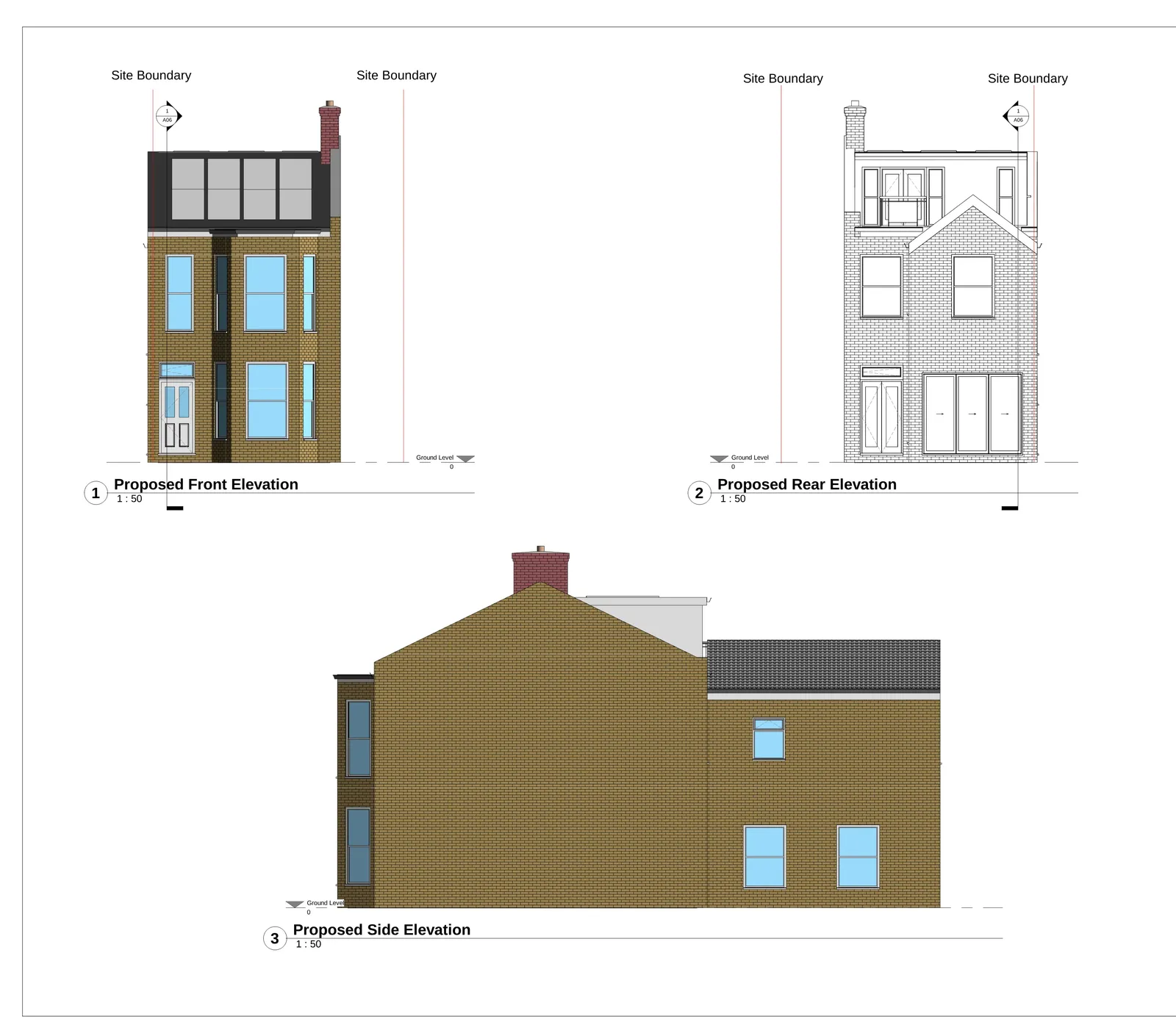
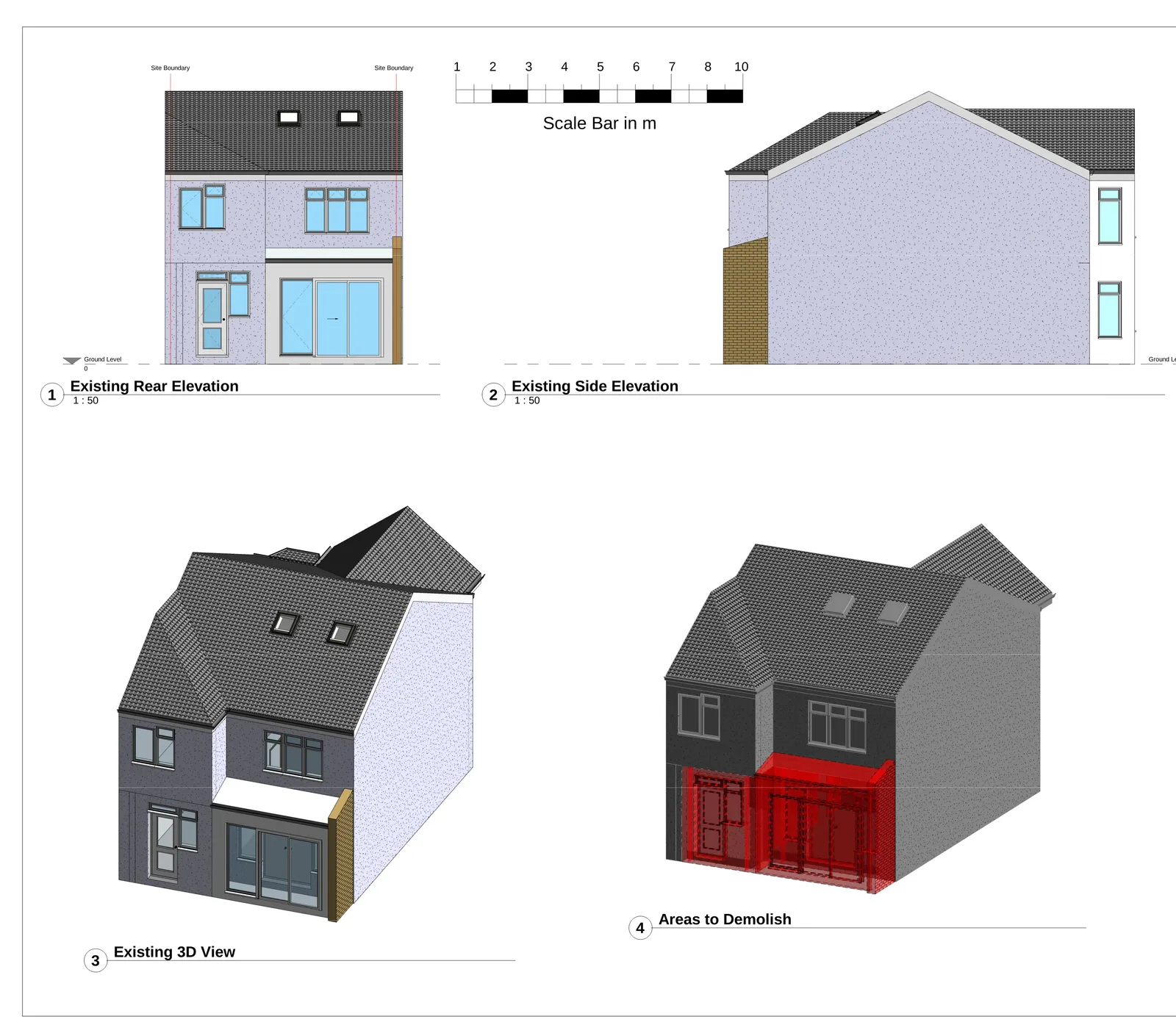
These example plan sheets show the type of architectural drawings, existing and proposed floor plans, elevations, roof plans, sections and 3D views Crown Architecture prepares for planning applications, permitted development, building control and residential design work. For homeowners, landlords and developers, Crown Architecture & Structural Engineering Ltd can prepare measured survey drawings, proposed layouts, planning drawings, building regulation drawings and supporting plan packages for extensions, loft conversions, garage conversions, internal alterations, HMO layouts and change-of-use applications.
Every project is reviewed around the property, the local authority requirements and the intended approval route, so the final drawing package is suitable for planning submission, building control coordination and contractor pricing where required.
Project imagery
Crown Architecture projects
Examples of the planning drawings, building regulation packages, and residential projects that this guide relates to.


Key information
What is Permitted Development?
Permitted development is a class of development that is automatically granted planning permission by national legislation — the Town and Country Planning (General Permitted Development) (England) Order 2015 (GPDO). It allows certain works to be carried out without the need to apply for planning permission from the local planning authority.
The GPDO is divided into Parts and Classes. Householder works are in Part 1, Class A (extensions), Class B (roof additions), Class C (roof alterations), Class D (porches), Class E (outbuildings), and Class F (hard surfacing). Each Class has its own set of conditions and limitations that must all be met for the works to be permitted development.
If any single condition in the relevant Class is not met, the works fall outside permitted development and a planning application is required. The conditions are not a menu to pick from — all of them must be satisfied simultaneously.
Need professional advice for your project? Crown Architecture offers free initial consultations.
Get a Free QuoteGuide section
Permitted Development Limits for Extensions
Under Class A of the GPDO, single-storey rear extensions to a house can be built without planning permission if they meet all the following conditions:
- For a detached house: maximum extension depth of 4m from the original rear wall
- For a terraced or semi-detached house: maximum extension depth of 3m from the original rear wall
- Maximum eaves height of 3m if within 2m of the boundary
- Maximum overall height of 4m
- Materials must be of similar appearance to the host building
- No extension forward of the front or side elevation of the original house
- Not on Article 1(5) land (includes National Parks, AONBs, conservation areas) for side extensions
- Combined extensions and outbuildings must not cover more than half the original curtilage
Guide section
The Prior Approval Notification Scheme
A separate provision — the Prior Approval notification scheme (Class A.1 of Part 1) — allows larger single-storey extensions without full planning permission, subject to neighbour consultation:
Detached houses: up to 8m rear extension depth
Terraced and semi-detached houses: up to 6m rear extension depth
The notification must be submitted to the planning authority, neighbours are consulted for 21 days, and the authority assesses only the impact on the amenity of neighbouring properties. If no objections are received or the authority is satisfied, the extension can proceed. The notification period is 42 days from submission to decision.
Guide section
Permitted Development for Loft Conversions
Under Class B of the GPDO, loft conversions can be carried out without planning permission if they meet the volume and other conditions:
- Volume limit: 40m³ for terraced houses, 50m³ for detached and semi-detached houses
- No extension beyond the plane of the existing roof slope on the principal (street-facing) elevation
- No addition higher than the highest part of the existing roof
- Materials of similar appearance to the existing house
- Any dormer to be set back at least 20cm from the eaves
- No verandah, balcony, or raised platform
- Not on Article 1(5) land for any addition that is not a rooflight
Guide section
Conservation Areas and Article 4 Directions
Permitted development rights are removed or restricted in conservation areas, Areas of Outstanding Natural Beauty, National Parks, and other designated areas. In conservation areas in London — and London has hundreds of them — key permitted development rights are restricted:
In a conservation area, any extension to the side of a house or any outbuilding within the curtilage of a house requires planning permission (Class A rights removed for side extensions on Article 1(5) land). Roof extensions that are visible from a highway require planning permission. Cladding, satellite dishes, and solar panels on street-facing elevations may require permission.
Article 4 directions are made by local planning authorities to remove specific permitted development rights in defined areas where the character of the area would otherwise be harmed. In London, many Article 4 directions remove rights to alter windows, doors, roof materials, and boundary walls in key residential conservation areas. A planning application is then required for works that would otherwise have been permitted development.
The practical consequence: a property in a conservation area or Article 4 direction zone may need a planning application for works that would be entirely automatic in an adjacent street.
Guide section
Lawful Development Certificate
A Lawful Development Certificate (LDC) is formal written confirmation from the planning authority that a proposed development is lawful — either because it falls within permitted development or because an existing use or development is established.
An LDC is not required to carry out works that are genuinely within permitted development — the rights apply automatically. But an LDC is strongly advisable when:
- The property is in or near a conservation area where permitted development limits are uncertain
- An Article 4 direction may apply — LDC confirms the position
- Previous works may have used up part of the permitted volume (cumulative additions count)
- A mortgage lender or buyer requires documentary confirmation
- The planning authority has a history of challenging works on similar properties nearby
- The property is listed (LDC confirms listed building consent is or is not required)
Common questions
Permitted Development vs Planning Permission: A Complete Guide for London Homeowners — frequently asked questions
Practical answers to the questions homeowners most often ask about this topic.
How do I know if my property is in a conservation area?
Conservation area boundaries are publicly accessible through your local planning authority's website. Most London boroughs have an online interactive map that shows conservation area boundaries overlaid on OS mapping. You can also check the national Historic England record and ask your planning authority directly. If in doubt, confirm the position before starting any works — a conservation area changes what is permitted development and what is not.
Can I lose permitted development rights for having done previous works?
Yes. Permitted development limits are cumulative — previous extensions, loft additions, and outbuildings all count toward the limits. If a previous owner has already used the full permitted development extension depth, a new extension will require planning permission even if it would otherwise be within the limits. Measuring the existing building against the original floor plan from when the house was first built (or first extended after restrictions applied) establishes the current position.
Is a Lawful Development Certificate the same as planning permission?
No. A Lawful Development Certificate confirms that no planning permission is required because the works are within permitted development (or that an existing use is lawful). Planning permission is granted in response to a planning application for works that are not within permitted development. They are different documents with different legal effect.
What happens if I build under permitted development and I was wrong?
If works were carried out under the mistaken belief that they were permitted development, the planning authority can take enforcement action if the works constitute a breach of planning control. This can require alteration or removal of the works at your expense. The breach becomes immune from enforcement after four years for dwellinghouses (from completion of the works). A retrospective planning application or LDC can regularise the position, but approval is not guaranteed.
Can a planning condition remove my permitted development rights?
Yes. Planning permissions sometimes carry conditions that remove all or some permitted development rights from the property as part of the consent. These are called Article 4 equivalent conditions. If your property was built with a planning permission that carries such a condition, your permitted development rights may be restricted even if the property is not in a conservation area. Check the conditions on any planning permissions affecting the property.
Can I clad my house without planning permission in London?
Under Class A of the GPDO, cladding an exterior wall with stone, artificial stone, pebble dash, render, timber, plastic, or tiles requires planning permission in conservation areas. Outside conservation areas, adding cladding of similar appearance to the existing house is generally permitted development for dwellinghouses. London has a very high density of conservation areas, so always check the designation before assuming cladding is automatically permitted.
Further reading
Related planning and design guides
More homeowner guides covering related planning, design, and technical topics.
Cost guide
How Much Does Planning Permission Cost in London? (2026 Guide)
Planning permission costs in London include the planning fee, professional drawings, and any support…
Heritage planning guide
Planning in a Conservation Area: A Complete Guide for London Homeowners
Living in a conservation area changes what you can do to your home. This guide explains the planning…
Planning guide
Article 4 Directions: What They Mean for Your London Property
Article 4 directions remove permitted development rights from specific areas. This guide explains wh…
Start your project
Get a free quote from Crown Architecture
Tell us about your project and we will respond within one working day with a fixed-fee proposal.
Call us on +44 7950 114633 or use our contact form to discuss your project and receive a fixed-fee proposal.
Contact UsReady to talk through your project?
Crown Architecture — Planning and design for London homes
Expert planning drawings, building regulation packages, and planning consultancy for extensions, loft conversions, and residential alterations across London and the home counties.